OUAN601 - COP3:
Final Storyboards
I would love for there to be a finished, final animation to go with these storyboards. However, being pressed for time meant that only a rough animatic at the most could be completed with little no animation... I am dissapointed by the lack of practical, but hope the dissertation and primary research will make up for this and prove that a lot of effort has been put into other areas of the project.
Animating Elmer's Context of Practice
Thursday, 7 January 2016
Friday, 13 November 2015
OUAN601 - COP3: Disney/Pixar & Mental Health
OUAN601 - COP3:
Disney/Pixar & Mental Health
Finding Nemo - Anterograde Amnesia
Dory. Need I say more? It is incredibly obvious that Dory's short-term memory loss is an indicator of a more serious form of amnesia. The story could be looked at as a point of optimism, especially for children who witness family members suffering from illness such as dementia and amnesia. It may teach them that their support and love regardless of a close relative's memory loss could actually help the sufferer: "I just... I remember things better with you" - Dory.
The Lion King - PTSD (Post-Traumatic Stress Disorder)
A child having to watch the brutal death of his father would be traumatic whichever way you look at it. Simba obviously suffered from seeing his uncle put his father to death and that is practically what the first film is about. It could be said that this is simply the natural course of trauma and grief and there implying mental illness is part of this film is, well, mad! (No pun intended!) Some of the symptoms of PTSD are recurrent flashbacks, numbing of emotional events, and hyperarousal - all potential warning signs for Simba. Considering TLK was based on Hamlet, the Shakespearean play, it is very much inevitable that a character would show signs of PTSD.
Shrek - SAD (Social Anxiety Disorder)
It could be argued that Shrek has elements of social anxiety and actively shows these symptoms throughout the films. It is mentioned that "ogres have layers" and Shrek has trouble opening up to the world around him. He puts on a front with the intention of scaring those around him away so he does not have to engage in social interaction or any threatening situations. For instance, when meeting Fiona's parents for the first time, he is intimidated in a very logical way, however his urge to avoid this situation could be down to his anxiety of rejection and judgement due to appearance and is so strong that he wishes to leave the event and makes a fuss about it.
Frozen - BPD (Borderline Personality Disorder)
Emotional instability, outbursts of anger, intense efforts to avoid real or perceived abandonment, and unstable interpersonal relationships. Sounds like Elsa. A lot, right? Affecting a whopping 1.6% of adults according to many articles, it can be a hard and horrible rollercoaster of emotional dysregulation, suicide, and self-harm. Although self-harm and suicide aren't tackled in this film (for obvious reasons), Elsa does engage in self-destructive behaviour, a clear pointer towards BPD.
Snow White and The Seven Dwarfs - Narcissistic Personality Disorder
For all of us who have watched it, and I can't think of anyone who hasn't, we all know too well that the Evil Queen has a touch of massive-ego syndrome. Talking to a mirror every single day to ask its opinion on your appearance is a little bit on the egocentric side. She's impulsive and cruel and feels nothing of it. You could argue that most evil villains have some form of disorder and it's quite obvious that she does.
Disney/Pixar & Mental Health
Finding Nemo - Anterograde Amnesia
Dory. Need I say more? It is incredibly obvious that Dory's short-term memory loss is an indicator of a more serious form of amnesia. The story could be looked at as a point of optimism, especially for children who witness family members suffering from illness such as dementia and amnesia. It may teach them that their support and love regardless of a close relative's memory loss could actually help the sufferer: "I just... I remember things better with you" - Dory.
The Lion King - PTSD (Post-Traumatic Stress Disorder)
A child having to watch the brutal death of his father would be traumatic whichever way you look at it. Simba obviously suffered from seeing his uncle put his father to death and that is practically what the first film is about. It could be said that this is simply the natural course of trauma and grief and there implying mental illness is part of this film is, well, mad! (No pun intended!) Some of the symptoms of PTSD are recurrent flashbacks, numbing of emotional events, and hyperarousal - all potential warning signs for Simba. Considering TLK was based on Hamlet, the Shakespearean play, it is very much inevitable that a character would show signs of PTSD.
Shrek - SAD (Social Anxiety Disorder)
It could be argued that Shrek has elements of social anxiety and actively shows these symptoms throughout the films. It is mentioned that "ogres have layers" and Shrek has trouble opening up to the world around him. He puts on a front with the intention of scaring those around him away so he does not have to engage in social interaction or any threatening situations. For instance, when meeting Fiona's parents for the first time, he is intimidated in a very logical way, however his urge to avoid this situation could be down to his anxiety of rejection and judgement due to appearance and is so strong that he wishes to leave the event and makes a fuss about it.
Frozen - BPD (Borderline Personality Disorder)
Emotional instability, outbursts of anger, intense efforts to avoid real or perceived abandonment, and unstable interpersonal relationships. Sounds like Elsa. A lot, right? Affecting a whopping 1.6% of adults according to many articles, it can be a hard and horrible rollercoaster of emotional dysregulation, suicide, and self-harm. Although self-harm and suicide aren't tackled in this film (for obvious reasons), Elsa does engage in self-destructive behaviour, a clear pointer towards BPD.
Snow White and The Seven Dwarfs - Narcissistic Personality Disorder
For all of us who have watched it, and I can't think of anyone who hasn't, we all know too well that the Evil Queen has a touch of massive-ego syndrome. Talking to a mirror every single day to ask its opinion on your appearance is a little bit on the egocentric side. She's impulsive and cruel and feels nothing of it. You could argue that most evil villains have some form of disorder and it's quite obvious that she does.
OUAN601 - COP3: LIFF - Film to Change
OUAN601 - COP3:
LIFF - Film to Change
One event that was of particular interest to me at Leeds International Film Festival was "Film to Change", a seminar/talk-type presentation led by Tom Bailey of Leeds Arts and Minds Network, and Gary Morris, a psychology lecturer a Leeds University.
The talk featured amateur film created by students and volunteers regarding the subject of mental health and what film can do to tackle and approach this whilst raising awareness, being informative, and engaging with a wide audience. Some of the short films were a little bit disappointing albeit a really good attempt. Some of them felt a little bit unfinished and flighty, with no real story or motive behind them. It was later said that some of the films had been created for company briefs, which was unusual as I didn't feel they were "complete" and professional enough to be used in a public setting.
I didn't mean to be so critical however, seeing some of the work students at my college can produce just made me think that the participants of a film festival could've been a little more ambitious as that standard wasn't as polished as some of the work I've seen amongst fellow LCoA students.
Gary Morris talked about mental health in international film and how that has influenced a greater understanding amongst poorer and less education-orientated cultures such as those in India, some South-East Asian cultures, and African communities. He spoke in depth about how some minorities, especially communities in West Africa, still believe very heavily in religion and spiritual healing rather than science and logical reason. This had an impact on how they thought of the mentally ill, and what treatment they prescribed their sufferers. Often this type of lifestyle inflicted great prejudice as it is believed in some cultures that evil spirits are responsible for mental health issues - especially in places where psychotic disorders and hallucinations are prevalent (which has been shown to be very high in the black population).
I have contacted Tom Bailey with request for him to send me the presentation that was shown so that I can gather some of the sources of information for my dissertation and research some of the facts and figures more thoroughly for my own knowledge. I am incredibly interested to find out how animation and film are used internationally to portray mental health, and how much of an impact they have on certain cultures.
With kind permission from the writer of the presentation and speaker at Film to Change, Gary Morris, here is a preview of the presentation we were shown at the festival. It is incredibly useful to anyone studying mental health, film, and the international and cultural aspects surrounding it.
LIFF - Film to Change
One event that was of particular interest to me at Leeds International Film Festival was "Film to Change", a seminar/talk-type presentation led by Tom Bailey of Leeds Arts and Minds Network, and Gary Morris, a psychology lecturer a Leeds University.
The talk featured amateur film created by students and volunteers regarding the subject of mental health and what film can do to tackle and approach this whilst raising awareness, being informative, and engaging with a wide audience. Some of the short films were a little bit disappointing albeit a really good attempt. Some of them felt a little bit unfinished and flighty, with no real story or motive behind them. It was later said that some of the films had been created for company briefs, which was unusual as I didn't feel they were "complete" and professional enough to be used in a public setting.
I didn't mean to be so critical however, seeing some of the work students at my college can produce just made me think that the participants of a film festival could've been a little more ambitious as that standard wasn't as polished as some of the work I've seen amongst fellow LCoA students.
Gary Morris talked about mental health in international film and how that has influenced a greater understanding amongst poorer and less education-orientated cultures such as those in India, some South-East Asian cultures, and African communities. He spoke in depth about how some minorities, especially communities in West Africa, still believe very heavily in religion and spiritual healing rather than science and logical reason. This had an impact on how they thought of the mentally ill, and what treatment they prescribed their sufferers. Often this type of lifestyle inflicted great prejudice as it is believed in some cultures that evil spirits are responsible for mental health issues - especially in places where psychotic disorders and hallucinations are prevalent (which has been shown to be very high in the black population).
I have contacted Tom Bailey with request for him to send me the presentation that was shown so that I can gather some of the sources of information for my dissertation and research some of the facts and figures more thoroughly for my own knowledge. I am incredibly interested to find out how animation and film are used internationally to portray mental health, and how much of an impact they have on certain cultures.
With kind permission from the writer of the presentation and speaker at Film to Change, Gary Morris, here is a preview of the presentation we were shown at the festival. It is incredibly useful to anyone studying mental health, film, and the international and cultural aspects surrounding it.
OUAN601 - COP3: Mental Health Questionnaire
OUAN601 - COP3:
A rough attempt at a questionnaire online proved to be very unsuccessful in terms of the answers I was receiving and the people I was reaching out to. In an attempt to be humourous, many responded with joke answers, which was funny at first but wasn't giving me any real results. Instead of an online form, I decided it would be best to rewrite some of the questions to sound more appropriate and to the point in the form of a print-out questionnaire. I set up some points around the college with signs next to them, attracting attention and gathering quick responses.
In total I only received about thirty replies, which isn't a great deal and not from a very large audience. The online option gave the benefit of reaching a large audience, whereas the print out variation could only be accessed by people close by, unless distributed outside the college, which I didn't have the time for.
Here is the more refined printable version.
A rough attempt at a questionnaire online proved to be very unsuccessful in terms of the answers I was receiving and the people I was reaching out to. In an attempt to be humourous, many responded with joke answers, which was funny at first but wasn't giving me any real results. Instead of an online form, I decided it would be best to rewrite some of the questions to sound more appropriate and to the point in the form of a print-out questionnaire. I set up some points around the college with signs next to them, attracting attention and gathering quick responses.
In total I only received about thirty replies, which isn't a great deal and not from a very large audience. The online option gave the benefit of reaching a large audience, whereas the print out variation could only be accessed by people close by, unless distributed outside the college, which I didn't have the time for.
Here is the more refined printable version.
Tuesday, 10 November 2015
OUAN601 - COP3: Anxious Animations Review
OUAN601 - COP3:
Anxious Animation Review
To inform both my practical and dissertation, it was recommended by a friend that I watch Anxious Animations as some of the effects, subjects, and styles seemed very appropriate for what I wanted to achieve for this module. After taking it out of the library, my first impressions from reading the breakdown on the back of the case weren't at all positive. It seemed very pretentious and 'artsy' in a way that didn't seem it would make much sense in relation to mental health. The animations didn't look (at first glance) all that great. They seemed very rushed, and looked almost like a five-year-old had grabbed and crayon, chugged 10 gallons of caffeine, and gone out of control!
However, after sitting down with my partner to watch what felt like a lifetime of awful animations, we actually understood and began to even enjoy a few of the animations featured on the DVD. I have a habit of only seeing things at face value and not looking too much into things for deeper meanings. My partner on the other hand is very much connotation-wise and understood some of the morals and messages that were conveyed.
One of the animators, Jim Trainor, focused on an almost dosumentary-type genre of animation, featuring two animations - one about the life of bats, the other about a made-up creature called the "moschops". Albeit really weird, using a black and white style which I liked, but very sketchy, rough, thin-lined, and wobbly, it was really interesting to watch and was definitely something I hadn't seen before. The use of loud, uneasy sound effects like animals eating food in an overly-exaggerrated manner made my skin crawl a bit, and was a bit of a sensory overload. This could be a relevant feature for my animation as auditory sensitivity can be an issue for some people suffering with mental health issues and would be best explored.
Anxious Animation Review
To inform both my practical and dissertation, it was recommended by a friend that I watch Anxious Animations as some of the effects, subjects, and styles seemed very appropriate for what I wanted to achieve for this module. After taking it out of the library, my first impressions from reading the breakdown on the back of the case weren't at all positive. It seemed very pretentious and 'artsy' in a way that didn't seem it would make much sense in relation to mental health. The animations didn't look (at first glance) all that great. They seemed very rushed, and looked almost like a five-year-old had grabbed and crayon, chugged 10 gallons of caffeine, and gone out of control!
However, after sitting down with my partner to watch what felt like a lifetime of awful animations, we actually understood and began to even enjoy a few of the animations featured on the DVD. I have a habit of only seeing things at face value and not looking too much into things for deeper meanings. My partner on the other hand is very much connotation-wise and understood some of the morals and messages that were conveyed.
One of the animators, Jim Trainor, focused on an almost dosumentary-type genre of animation, featuring two animations - one about the life of bats, the other about a made-up creature called the "moschops". Albeit really weird, using a black and white style which I liked, but very sketchy, rough, thin-lined, and wobbly, it was really interesting to watch and was definitely something I hadn't seen before. The use of loud, uneasy sound effects like animals eating food in an overly-exaggerrated manner made my skin crawl a bit, and was a bit of a sensory overload. This could be a relevant feature for my animation as auditory sensitivity can be an issue for some people suffering with mental health issues and would be best explored.
Thursday, 29 October 2015
OUAN601 - COP3: Initial Thumbnailing & Scripting
OUAN501 - COP3:
Initial Thumbnailing & Scripting
Beginning the initial idea and character production for my COP3 practical was rather easy to get into as I was so engrossed in my subject. I wanted to create a rather androgynous character as not to draw attention away from their facial features and bodily movement. Mental health issues affect everyone of all backgrounds, genders, and ethnicities so I believed it was important to get this message across by not decorating my character or designing their body in any obvious way.
The character itself features a rather large head in comparison to its body height - one quarter in fact. This is to make it easier to identify with their facial expressions, an important factor in my animated story. The limbs are rather basic, with little to no fingers or toes unless in the instance of contact with objects. This simplicity allows the viewer to focus on the story and emotion, rather than the overall aesthetic of the piece.
Background production will be a rather tedious task as I plan on looking at German Expressionism a little more to understand how backgrounds were created to provoke a sense of unreality on the audience. Many-point perspectives may be necessary along with unusual camera angles to depict the character's relation with their environments.
I began by sketching down my initial thoughts and ideas in the correct format (16:9) to get a sense of how the character will move and flow within the space. In the first scene especially, the feeling of lonliness is very prevelant and must be portrayed well through the use of both character animation and environment.
German Expressionism seems to be highly preoccupied with reflective surfaces. I'm not interested in keeping completely consistent with the style as my my main aim is simplicity. I believe I can achieve a sense of 'unreality' through minimalism and will demonstrate this through some of my environmental/background designs.
Below are my really rough, initial ideas for a storyboard. This would then be the basis for my more refined attempts at a storyboard, of which took many tries to get completely right.
Initial Thumbnailing & Scripting
Beginning the initial idea and character production for my COP3 practical was rather easy to get into as I was so engrossed in my subject. I wanted to create a rather androgynous character as not to draw attention away from their facial features and bodily movement. Mental health issues affect everyone of all backgrounds, genders, and ethnicities so I believed it was important to get this message across by not decorating my character or designing their body in any obvious way.
The character itself features a rather large head in comparison to its body height - one quarter in fact. This is to make it easier to identify with their facial expressions, an important factor in my animated story. The limbs are rather basic, with little to no fingers or toes unless in the instance of contact with objects. This simplicity allows the viewer to focus on the story and emotion, rather than the overall aesthetic of the piece.
Background production will be a rather tedious task as I plan on looking at German Expressionism a little more to understand how backgrounds were created to provoke a sense of unreality on the audience. Many-point perspectives may be necessary along with unusual camera angles to depict the character's relation with their environments.
I began by sketching down my initial thoughts and ideas in the correct format (16:9) to get a sense of how the character will move and flow within the space. In the first scene especially, the feeling of lonliness is very prevelant and must be portrayed well through the use of both character animation and environment.
German Expressionism seems to be highly preoccupied with reflective surfaces. I'm not interested in keeping completely consistent with the style as my my main aim is simplicity. I believe I can achieve a sense of 'unreality' through minimalism and will demonstrate this through some of my environmental/background designs.
Below are my really rough, initial ideas for a storyboard. This would then be the basis for my more refined attempts at a storyboard, of which took many tries to get completely right.
Monday, 19 October 2015
OUAN601 - COP3: Dissertation Secondary Research (Reading List & Other Secondary Materials)
OUAN601 - COP3:
Dissertation Secondary Research
Online Material
Brosh, A., 2009. Hyperbole and a Half. [Online]
Patel, N. V., 2015. Inverse - How Tim Burton’s “Alice
In Wonderland” Can Detect Psychosis. [Online]
News, B., 2009. Cartoons 'could help spot autism'. [Online]
Minds, A., 2015. Animated Minds. [Online]
Kendrick, K., 2015. Teenager With Walking Corpse Syndrome Brought Back To Life By Disney Films. [Online]
De, O., n.d. 10 Cartoon Characters with Psychological Disorders. [Online]
Choices, N., 2009. Cartoons to identify autism. [Online]
America, M. H., 2013. Mind Over Pop Culture: Adventure Time "I Remember You". [Online]
Films/Animations
Sensory Overload. 2013. [Film] Directed by
Miguel Jiron. USA: s.n.
Skhizein. 2008. [Film] Directed by Jérémy Clapin. France: Dark Prince.
Of Two Minds. 2012. [Film] Directed by Lisa J. Klein Douglas Blush. USA: MadPix.
Anxious Animations. 2006. [Film] Directed by Janie Geiser, Jim Trainor, Henry Garon Ascher Lewis Klahr. s.l.: Other Cinema.
Books
Beauchard, D., 2006. Epileptic. London: Jonathan Cape.
Gemma Blackshaw, L. T., 2009. Madness and Modernity - Mental Illness and the Visual Arts in Vienna 1900. Surrey: Lund Humphries.
Maclagan, D., 2001. Psychological Aesthetics - Painting, Feeling and Making Sense. London: Jessica Kingsley.
Shoham, S. G., 2002. Art, Crime and Madness. Brighton:
Sussex Academic Press.
Cunningham, D., 2011. Psychiatric Tales. 1st ed. New York: Bloomsbury.
Cashell, K., 2009. Aftershock. New York: I.B Tauris & Co Ltd.
Adams, L. S., 1994. Art and Psychoanalysis. New York: HarperCollins Publishers.
OUAN601 - COP3: Character Design
OUAN601 - COP3:
Character Design
In relation to my protagonist for my practical, I have looked at various different styles and decided on a very blank, simple design as not to detract away from the main purpose of the animation, and the other stylised features such as the set design. I have tried incorporating the same black and white style that I wished on using as this was what made Darryl Cunningham's work stand out to me and inspire me to make a piece regarding mental health.
The character will feature large eyes, making the expression very obvious and clear to the audience. Large eyes have a certain amount of appeal, especially with children, so this will be useful in making my character identifiable and loveable. Their body will very bendy, with exaggerrated movement on the limbs to make their mood very distinct and dramatic. I planned on keeping them androgynous as not to make their story biased towards any particular gender - I want the message to be understandable that mental illness can affect anyone!
No nose is needed, of which I discovered during the 'design and sketching out ideas' period. I felt this because a nose is only really needed to show a clear connection between the character and their direction in which they're facing, and that's not really too important here. I wanted to keep them as simple and minimalistic as possible to contrast with a possibly very-well detailed environment.
I have researched Tim Burton and German Expressionist styles and felt they were too complex and detailed for what I was trying to achieve with my character. Below are some of the sketches I whacked out in the design process.
After playing about with the above style of eyes, no nose, and mouth, various comments and helpful feedback led me to change this design and refine my ideas more. It was suggested that giving the character a nose and no mouth would not only define the face a little more, help it feel more stylised and less "flat", no mouth would help give the impression that the character was "expressionless" and virtually unable to smile, express themself, and show meaningful emotion that wasn't influenced by mental health. The smile was suggested to only appear right at the very end, when the they finally seek help and there is a glimpse of hope. Below are some more refined designs showing the bendiness and fluidity of their body (and fluidity of their gender as none is made obvious in these designs, I feel).
Character Design
In relation to my protagonist for my practical, I have looked at various different styles and decided on a very blank, simple design as not to detract away from the main purpose of the animation, and the other stylised features such as the set design. I have tried incorporating the same black and white style that I wished on using as this was what made Darryl Cunningham's work stand out to me and inspire me to make a piece regarding mental health.
The character will feature large eyes, making the expression very obvious and clear to the audience. Large eyes have a certain amount of appeal, especially with children, so this will be useful in making my character identifiable and loveable. Their body will very bendy, with exaggerrated movement on the limbs to make their mood very distinct and dramatic. I planned on keeping them androgynous as not to make their story biased towards any particular gender - I want the message to be understandable that mental illness can affect anyone!
No nose is needed, of which I discovered during the 'design and sketching out ideas' period. I felt this because a nose is only really needed to show a clear connection between the character and their direction in which they're facing, and that's not really too important here. I wanted to keep them as simple and minimalistic as possible to contrast with a possibly very-well detailed environment.
I have researched Tim Burton and German Expressionist styles and felt they were too complex and detailed for what I was trying to achieve with my character. Below are some of the sketches I whacked out in the design process.
After playing about with the above style of eyes, no nose, and mouth, various comments and helpful feedback led me to change this design and refine my ideas more. It was suggested that giving the character a nose and no mouth would not only define the face a little more, help it feel more stylised and less "flat", no mouth would help give the impression that the character was "expressionless" and virtually unable to smile, express themself, and show meaningful emotion that wasn't influenced by mental health. The smile was suggested to only appear right at the very end, when the they finally seek help and there is a glimpse of hope. Below are some more refined designs showing the bendiness and fluidity of their body (and fluidity of their gender as none is made obvious in these designs, I feel).
OUAN601 - COP3: Practical Research
OUAN601 - COP3:
Practical Research
"Real Monsters Art" by Toby Allen was sent to me by a fellow animator and looked incredibly interesting due to the fact that I will possibly be creating my own creatures or 'hallucinations' for my practical animation(s). Toby Allen creates monsters that represent different mental disorders and exactly why their appearance reflects how they manifest and show themselves.
M.C Escher's work will be fairly relevant as I plan to look at the ways he uses perception and perspective to create a sense of uncertainty and surrealism. His works feature highly mathematical-based geometry which could reflect the way a delusional or hallucinating mind uses heavy symbolism, often featuring numbers, geometry, and personal imagery. German Expressionism, which inspired Tim Burton seems have a very macabre feel to it and would be good to analyse and use as inspiration for some of the environmental design in my animation(s) as I would like to represent how it feels to live with hallucinations and a sense of reality being taken away. The idea of distortion and playing between what is real and what is confined within the mind is incredibly hard to interpret to an audience whose versions of reality are fairly unclouded, so using German Expressionism as a means of inspiration (we can all agree that Escher's and even Burton's re-worked version of the style challenges reality and makes us wonder if our mind is playing tricks (Metamorphosis II by M.C Escher cleverly plays between 2D and 3D perception.)
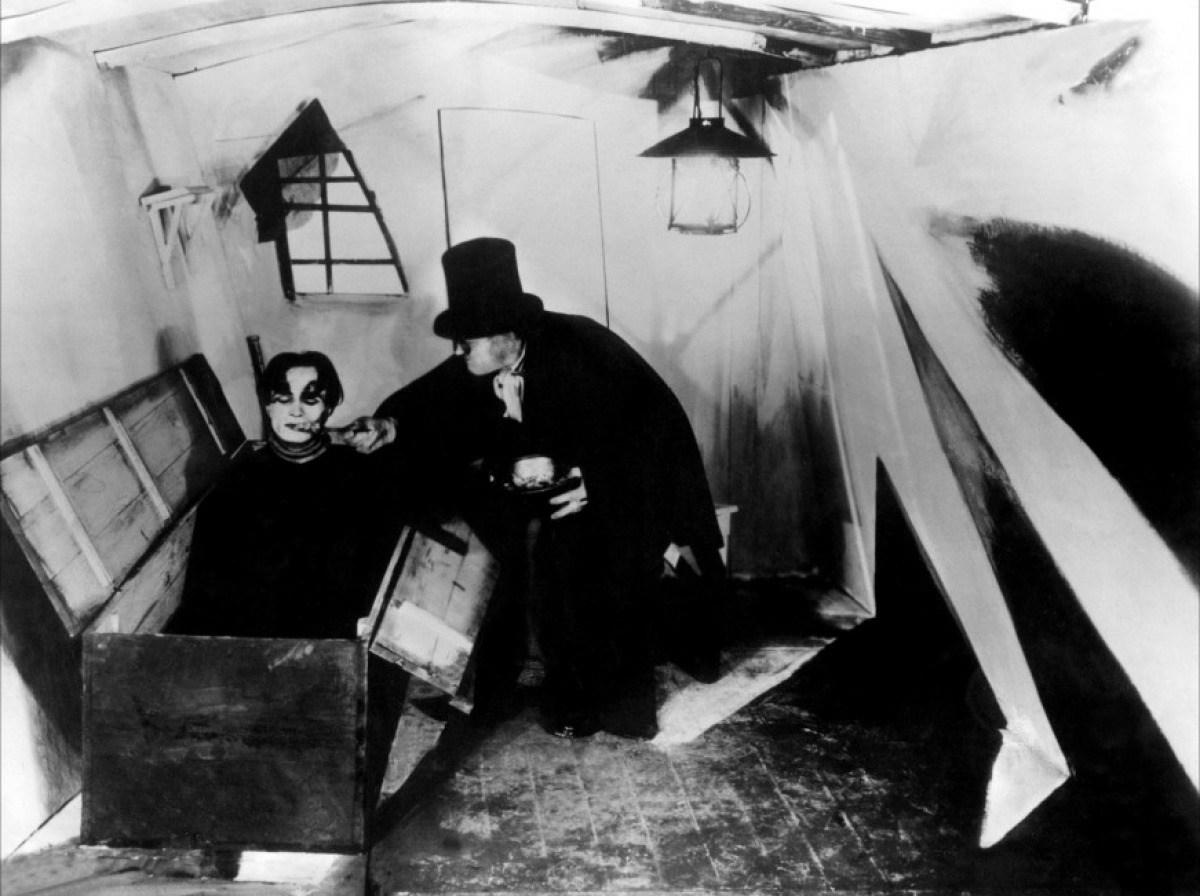
The Cabinet of Dr. Caligari could also be analysed and looked at from this point of view with the means to understand how camera angle and distortion of the backgrounds can create an alternate reality and mess with our heads. Nosferatu is another German Expressionist film that uses similar techniques and would be useful to watch.
'Psychiatric Tales' as I have already spoken about has been a massive influence for my practical as I feel I can confidently approach a difficult subject in a way that is informative and helpful to others without being too offensive and without the need to sensationalise other people's difficult issues.
Practical Research
"Real Monsters Art" by Toby Allen was sent to me by a fellow animator and looked incredibly interesting due to the fact that I will possibly be creating my own creatures or 'hallucinations' for my practical animation(s). Toby Allen creates monsters that represent different mental disorders and exactly why their appearance reflects how they manifest and show themselves.
M.C Escher's work will be fairly relevant as I plan to look at the ways he uses perception and perspective to create a sense of uncertainty and surrealism. His works feature highly mathematical-based geometry which could reflect the way a delusional or hallucinating mind uses heavy symbolism, often featuring numbers, geometry, and personal imagery. German Expressionism, which inspired Tim Burton seems have a very macabre feel to it and would be good to analyse and use as inspiration for some of the environmental design in my animation(s) as I would like to represent how it feels to live with hallucinations and a sense of reality being taken away. The idea of distortion and playing between what is real and what is confined within the mind is incredibly hard to interpret to an audience whose versions of reality are fairly unclouded, so using German Expressionism as a means of inspiration (we can all agree that Escher's and even Burton's re-worked version of the style challenges reality and makes us wonder if our mind is playing tricks (Metamorphosis II by M.C Escher cleverly plays between 2D and 3D perception.)
| Left - Drawing Hands (Escher) Right - Relativity (Escher) |
The Cabinet of Dr. Caligari could also be analysed and looked at from this point of view with the means to understand how camera angle and distortion of the backgrounds can create an alternate reality and mess with our heads. Nosferatu is another German Expressionist film that uses similar techniques and would be useful to watch.
| Still from 'The Cabinet of Dr. Caligari' |
OUAN601 - COP3: Dissertation Primary Research
OUAN601 - COP3:
Dissertation Research
As part of my dissertation research, I planned to contact and visit some professional companies and practitioners to ask them some valuable questions and learn about the work they are undertaking that is relevant to the way mental health is portrayed in animation.
So far I have spoken to Darryl Cunningham, illustrator and creator of 'Psychiatric Tales', a graphic novel about his time as a mental health worker and the difficulties he encountered. I emailed him regarding his views on the way in which animation depicts psychological issues and what he would do differently if he were to create an animated piece of his illustrated works. He replied with a very detailed and helpful response as he agreed that it can be very difficult to appropriate animation in a way in which is suitable and with the sole purpose to inform without being offensive or too controversial. Facts are key to authenticity:
"Hi Grace
Thanks for your kind words. I'm always pleased when people tell me that my work has helped or inspired them. I've tried to answer your questions below...
Yes I do think they're appropriate. Why not? As long as they are respectful to the people documented and are backed by facts rather than myths, then I think both illustration and animation have a lot to offer. They are easy to consume and can present a great deal of information quickly. My own approach, no matter what the subject, is to make the drawing within my comic strip panels as simple as possible. I often have a lot of information to present, so I don't want the reader to be confused by difficult page layouts or confusing imagery. Just because something looks easy to read doesn't mean that it can't resonate with people on a deep level and contain complex messages.
For people who suffer from a mental illness reading can be therapeutic, assuming of course, that they have the concentration. For those who are distressed it will help distract them from tormenting thoughts. Watching an animation might be even easier as a way of giving therapeutic help.
Hope that helps
Best"
I contacted Allie Brosh ('Hyperbole and A Half: Adventures in Depression' creator) to ask his opinions on animated works tackling this subject. However, there has been no reply despite a few pokes and nudges of encouragement. On a brighter note, I will be visiting Thought Bubble 2015 to try and hand out a questionnaires and achieve a response rate of at least 200+ people (I'm probably being ambitious!) I have yet to hand out the questionnaires to a smaller group within college to see whether or not it will be successful on a larger scale.
Dissertation Research
As part of my dissertation research, I planned to contact and visit some professional companies and practitioners to ask them some valuable questions and learn about the work they are undertaking that is relevant to the way mental health is portrayed in animation.
So far I have spoken to Darryl Cunningham, illustrator and creator of 'Psychiatric Tales', a graphic novel about his time as a mental health worker and the difficulties he encountered. I emailed him regarding his views on the way in which animation depicts psychological issues and what he would do differently if he were to create an animated piece of his illustrated works. He replied with a very detailed and helpful response as he agreed that it can be very difficult to appropriate animation in a way in which is suitable and with the sole purpose to inform without being offensive or too controversial. Facts are key to authenticity:
"Hi Grace
Thanks for your kind words. I'm always pleased when people tell me that my work has helped or inspired them. I've tried to answer your questions below...
Yes I do think they're appropriate. Why not? As long as they are respectful to the people documented and are backed by facts rather than myths, then I think both illustration and animation have a lot to offer. They are easy to consume and can present a great deal of information quickly. My own approach, no matter what the subject, is to make the drawing within my comic strip panels as simple as possible. I often have a lot of information to present, so I don't want the reader to be confused by difficult page layouts or confusing imagery. Just because something looks easy to read doesn't mean that it can't resonate with people on a deep level and contain complex messages.
For people who suffer from a mental illness reading can be therapeutic, assuming of course, that they have the concentration. For those who are distressed it will help distract them from tormenting thoughts. Watching an animation might be even easier as a way of giving therapeutic help.
Hope that helps
Best"
I contacted Allie Brosh ('Hyperbole and A Half: Adventures in Depression' creator) to ask his opinions on animated works tackling this subject. However, there has been no reply despite a few pokes and nudges of encouragement. On a brighter note, I will be visiting Thought Bubble 2015 to try and hand out a questionnaires and achieve a response rate of at least 200+ people (I'm probably being ambitious!) I have yet to hand out the questionnaires to a smaller group within college to see whether or not it will be successful on a larger scale.
The plan is to contact David Firth of Fat Pie for his opinions on 'Salad Fingers' and mental health. One of my chapters/topics I chose to write about was the sensationalisation of mental health and how this can affect an audience into believing illness is a 'trend'. I believe that certain cartoons and pieces could well be seen as culprits for popularising topics such as depression, anxiety, and psychosis to name a few. I wish to understand why he chose to deliver 'Salad Fingers' in such a shocking way.
I also wish to contact Biomation in York who work on mental health animations aimed a younger audience. This would be particularly helpful as I would like to understand the differences between how this subject is shown and appropriated for different audiences. Biomation use characters and puppets to relate more to the audience and have a more personal connection without being too heavy.
I'll be visiting LIFF (Leeds International Film Festival) soon to go and see The Cabinet of Dr. Caligari as research into style and how German Expressionism was used to influence Tim Burton (who hints at mental health with his creepy style and techniques), and to watch a talk on 'Film to Change', a talk and screening on mental illness and animation.
I've also been looking into an 'Animation and Public Engagement Symposium' at the Tyneside Cinema in Newcastle with HEART (Healing Education Animation Research Therapy). This would be relevant for a couple of modules as I'm looking into teaching and art therapy so might be worth going to just to see what's going on. Animation Therapy 2015
Thursday, 19 March 2015
OUAN501 - COP2: Character Inspiration
OUAN501 - Character Inspiration:
Adorning some of my characters are patterns, items of clothing relevant to their chosen origin, and accessories. When looking at the Japanese anime character for instance, it might not be clear as to why she has a kimono - a traditional piece - alongside some angel wings. This is because modern anime features a lot of cute, girly accessories and are often crucial to the characters' storyline.
The Russian man is covered with patterns on his sleeves. These are a traditional Russian folk pattern and look a little bit like postage stamps at first glance. They are often gold and red/green to signify wealth and stature.
The Middle Eastern man seems very plain to begin with, however the classic look of a 'sheikh' is plain, clean white clothes, possibly to stand for purity and cleanliness. White is a colour of holiness and I guess being such as secular part of the world seems appropriate to use this colour/shade. His scarf around his shoulders is covered in green, red, and yellow. This makes a nice contrast from all the white and his blue and white striped 'kaffiyeh' on his head also makes a nice tough of colour.
Adorning some of my characters are patterns, items of clothing relevant to their chosen origin, and accessories. When looking at the Japanese anime character for instance, it might not be clear as to why she has a kimono - a traditional piece - alongside some angel wings. This is because modern anime features a lot of cute, girly accessories and are often crucial to the characters' storyline.
The Russian man is covered with patterns on his sleeves. These are a traditional Russian folk pattern and look a little bit like postage stamps at first glance. They are often gold and red/green to signify wealth and stature.
The Middle Eastern man seems very plain to begin with, however the classic look of a 'sheikh' is plain, clean white clothes, possibly to stand for purity and cleanliness. White is a colour of holiness and I guess being such as secular part of the world seems appropriate to use this colour/shade. His scarf around his shoulders is covered in green, red, and yellow. This makes a nice contrast from all the white and his blue and white striped 'kaffiyeh' on his head also makes a nice tough of colour.
Wednesday, 18 March 2015
OUAN501 - COP2: Finished Character Designs
OUAN501 - Finished Character Designs:
After finishing the outlines and adding some clothes using reference materials in order to gather information of my chosen parts of the world, patterns used and so forth, I then proceeded to colour them in and finish them up with a little bit of shading and highlights. I narrowed my decisions down to three designs as six seemed too much so I went for three finished designs in an Americanized style instead of a transformation animation (which yes, would've been more successful but would take too much time).
OUAN501 - COP2: Initial Character Sketches
OUAN501 - Initial Sketches:
To get a rough idea of what character I was aiming for, I did a few initial rough sketches outlining the body types, genders, and original styles of each character. Each character in this original set will conform as much as possible to original cultural identities and then will be transformed into their Americanized counterparts.
I chose one female character and two male characters in order to get more practice in drawing males. I also wanted to stray away from drawing female characters all the time as I feel it won't expand my technical abilities as an animator and concept artist.
The pink outlines allowed me to get an understanding of where the joints would be whereas the the blue outlines were rough sketches over the top of the skeleton to get an idea of shape and stature. The American characters will be posed differently but the head will remain in the same position to give the idea of a sharp transition from one cultural pose to a more action-packed pose.
To get a rough idea of what character I was aiming for, I did a few initial rough sketches outlining the body types, genders, and original styles of each character. Each character in this original set will conform as much as possible to original cultural identities and then will be transformed into their Americanized counterparts.
I chose one female character and two male characters in order to get more practice in drawing males. I also wanted to stray away from drawing female characters all the time as I feel it won't expand my technical abilities as an animator and concept artist.
The pink outlines allowed me to get an understanding of where the joints would be whereas the the blue outlines were rough sketches over the top of the skeleton to get an idea of shape and stature. The American characters will be posed differently but the head will remain in the same position to give the idea of a sharp transition from one cultural pose to a more action-packed pose.
Tuesday, 17 March 2015
OUAN501 - COP2: 500 Word Analysis of Academic Text
OUAN501 - COP2:
As part of writing my essay for Context of Practice, one
source I found particularly useful was that of Art in the Age of Mass Media by J. Walker. I discovered that there
were many interesting points and factors to aid me in writing the essay and
seeing as the topic of this book is closely connected with that of my work, I
felt it was only appropriate to read it and cite some quotes to back up my
points.
The chapter I enjoyed the most was The Mass Media and Mass Culture. I found it was very opinionated
yet factual and accurate in its discourse. This chapter talked about how
although globalisation and Americanisation are considered a negative influence
on outside cultures by so many of us, without it there would be many problems
that would affect our day to day lives. It mentioned briefly that there are
definitely positives to the mass spread of American culture and technology as
it has done plenty of good.
‘Billions of people have become consumers of culture’ is an
interesting quote used to describe how globalisation has lead us into a world
and way of life that when something new and unusual is done by say, a
television show, a ‘celebrity’, or even a new trend on the internet, millions
of us will actively endorse this and spend money to become part of that culture
and trend as a means of gaining popularity and notoriety. Sadly, this is very
wrong and wipes out our sense of self completely as any form of true identity
is taken away from us in our feeble attempt to become known by becoming ‘one of
the crowd’.
‘On the positive side, technology and mechanical reproduction
have brought about a tremendous democratization of culture’ is indeed very
true. Globalisation has, in a way, brought us together and although this has
come at the cost of our identities and cultural expression, it has allowed us
to mass communicate and share ideas on a global scale. We have been able to do
things that would have been impossible hundreds of years ago where even towns only
a several few hundred miles away from each other had completely different
identities.
The book goes on to talk about the impact it could have on us
in the future and whether or not Americanisation may not even be a part of our
lives anymore due to another culture taking over and forcing us into a
completely new set of ideals and ways to run our lives around. I find the book
a fantastic read as it has helped immensely with my essay. It has opened my
eyes to the world in a different light and allows me to think about the future
of globalisation and how it will affect the entire world’s population and not
just myself. I highly recommend this to anyone who wishes to write about such
an interesting topic.
Friday, 13 March 2015
OUAN501 - COP2: Character Design Research and Reference Part 2
OUAN501 - COP2:
To help with inspiration and reference when putting my characters together, I decided to look at three aspects of animation; Middle Eastern, Eastern European, and East Asian (predominantly anime). I chose to look at traditional clothing, historical aspects, and other potential influences on a character's appearance in relation to their culture. For my six character designs, I planned to draw out three original characters that were true to and resembled their national identities followed by three Westernised versions of them.
For example, I will take my Russian/Czech-style character and use as much reference from animations of those regions in order to create my own design. I will then base the changed version of the European character on styles from that of traditional Disney (elegant character, very idyllic in appearance). For the anime style character, the changed version will be using reference from such companies as Pixar and Dreamworks as films like Big Hero 6 have already taken a Japanese style and Americanised it like I plan to do. For the Middle Eastern character, I will use reference from Hannah Barbera and Warner Bros to create a very cartoony and exaggerated, silly character.
To give a good balance of gender and some more practice in anatomy for myself, I plan to use a female anime character, and two male characters of Middle Eastern and Eastern European origins. I feel that I can express the styles better by using two males from regions where males are seen as (sadly) more privileged. Although it could be argued that males are more privileged in Japan too.
To help with inspiration and reference when putting my characters together, I decided to look at three aspects of animation; Middle Eastern, Eastern European, and East Asian (predominantly anime). I chose to look at traditional clothing, historical aspects, and other potential influences on a character's appearance in relation to their culture. For my six character designs, I planned to draw out three original characters that were true to and resembled their national identities followed by three Westernised versions of them.
For example, I will take my Russian/Czech-style character and use as much reference from animations of those regions in order to create my own design. I will then base the changed version of the European character on styles from that of traditional Disney (elegant character, very idyllic in appearance). For the anime style character, the changed version will be using reference from such companies as Pixar and Dreamworks as films like Big Hero 6 have already taken a Japanese style and Americanised it like I plan to do. For the Middle Eastern character, I will use reference from Hannah Barbera and Warner Bros to create a very cartoony and exaggerated, silly character.
To give a good balance of gender and some more practice in anatomy for myself, I plan to use a female anime character, and two male characters of Middle Eastern and Eastern European origins. I feel that I can express the styles better by using two males from regions where males are seen as (sadly) more privileged. Although it could be argued that males are more privileged in Japan too.
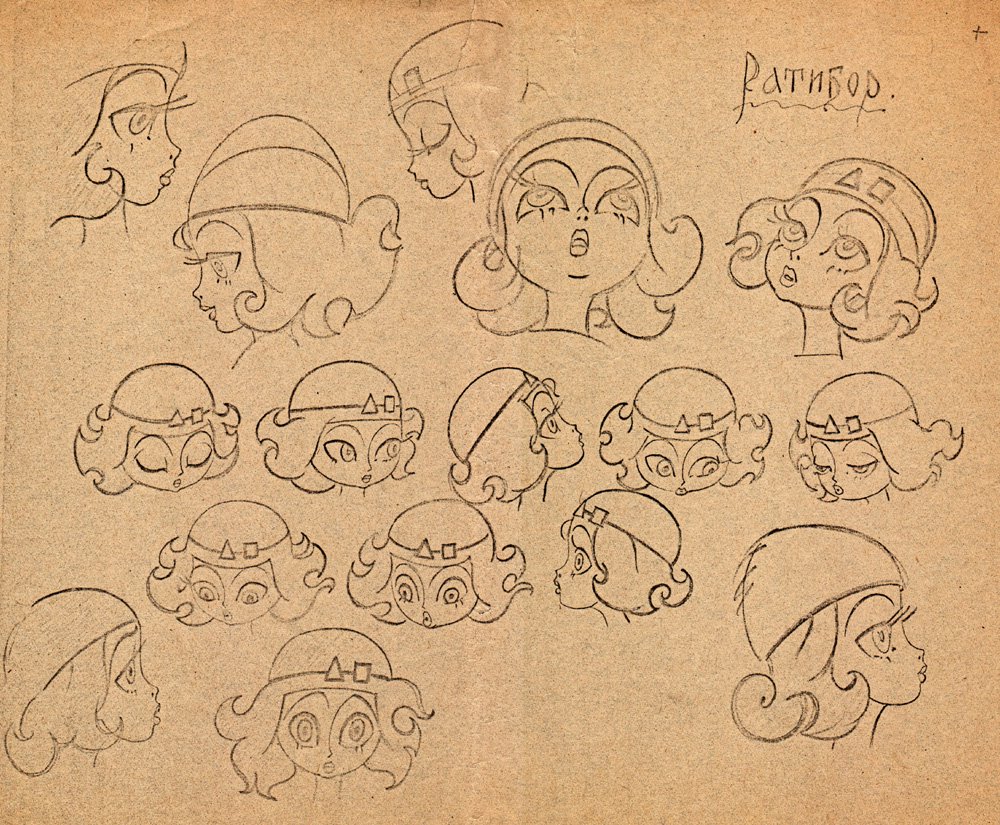
http://photos1.blogger.com/blogger/5802/1865/1600/ratibor6.0.jpg
(E.U reference)
http://img1.ak.crunchyroll.com/i/spire1/07232008/b/8/4/8/b84894b3592f20_full.jpg
(Anime reference)
(Middle Eastern version of Sim City - reference)
http://fc08.deviantart.net/fs7/i/2005/261/8/4/Jamshid_and_Khorshid_by_soheildanesh.jpg
('Iranime' - Iranian anime is starting to creep into the Middle East but still retains a distinct style)
Middle East - Warm, deep, purples, red, plums, yellows
Eastern European - Dark greys, browns, reds, blues, golds
East Asian - Bright colours, pinks, purples, greens, blues, pastels
Tuesday, 24 February 2015
OUAN501 - COP2: Character Design Research and Reference
OUAN501 - Character Design Research and Reference:
As reference for the practical side of my Context of Practice module, I chose to look at three different cultural identities within animation - East Asian (Japanese Anime), Eastern European (Czech/Polish/Ukrainian), and Middle Eastern (Emirati/Iranian/Saudi)
styles. My aim for the practical is to create a short series of three animated characters each with their own cultural identity and style relating to their origin. At first they will all appear "Americanised" - possibly even "Disneyfied" - as their features, accessories, and clothing will all be representative of American culture. The exterior of each character will then melt and drip away to reveal their underlying identities. They will look perished and sad as if to plead to the audience and prove that Americanisation in animation is washing away culture on a global scale.
The American-clad characters will be influenced by such styles as Marvel, DC, Disney, and Pixar. Each animated character will last around ten seconds each, a thirty second animation in total with each character running back to back. At the end to give some clarity to the purpose of my animations, a short end title will be added featuring a brief word or sentence about Americanisation and Globalisation in the animation industry.
As reference for the practical side of my Context of Practice module, I chose to look at three different cultural identities within animation - East Asian (Japanese Anime), Eastern European (Czech/Polish/Ukrainian), and Middle Eastern (Emirati/Iranian/Saudi)
The American-clad characters will be influenced by such styles as Marvel, DC, Disney, and Pixar. Each animated character will last around ten seconds each, a thirty second animation in total with each character running back to back. At the end to give some clarity to the purpose of my animations, a short end title will be added featuring a brief word or sentence about Americanisation and Globalisation in the animation industry.
An example of Middle Eastern animation styles - note the conservative and modest appearance of the women, despite the use of bright colours to make them look more appealing to children. "There’s a new bunch of super-heroes coming to international TV station Cartoon Network – in the form of four Emirati grandmothers. Vision finds out about the development of Emirati cartoon Freej, already a sensation in Dubai and now available to view on a screen near you." - Vision
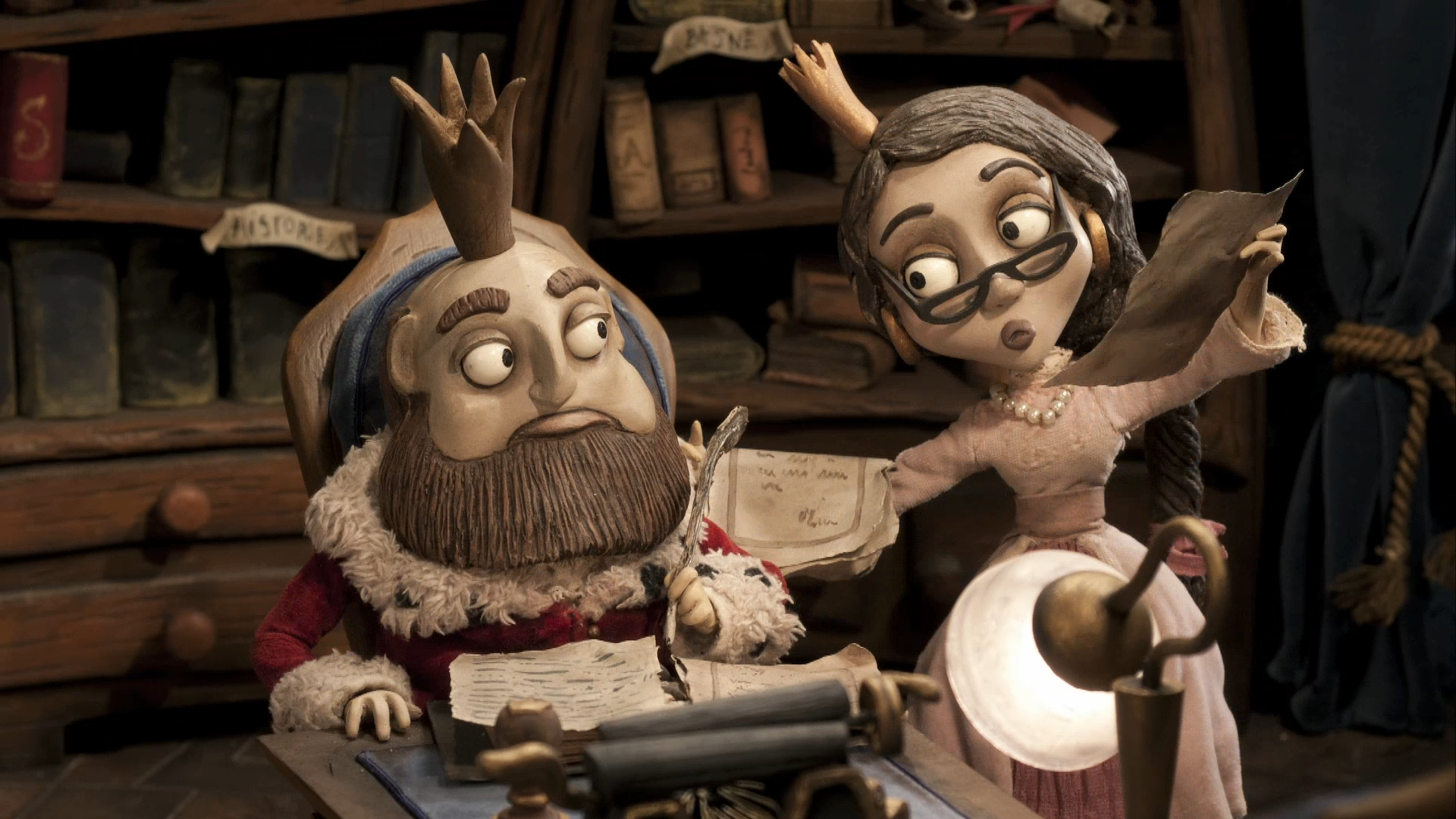
Examples of Czech animation show a rather dark style. Darker, warmer colours and a slight feeling of 'the uncanny' seem to be consistent and fairly common in Eastern European animation. The above images are from an animation called 'Fimfarum'.
Great Teacher Onizuka (1999) and Momotaro Umi No Shinpei (1945). Large, exaggerated features and cute mascots are typically a feature of most Japanese animations. Despite the huge change in style (anime has become fairly Westernised due to Globalisation), it is still very obvious that it is a Japanese animation style.
Subscribe to:
Comments (Atom)