OUAN501 - COP3:
Initial Thumbnailing & Scripting
Beginning the initial idea and character production for my COP3 practical was rather easy to get into as I was so engrossed in my subject. I wanted to create a rather androgynous character as not to draw attention away from their facial features and bodily movement. Mental health issues affect everyone of all backgrounds, genders, and ethnicities so I believed it was important to get this message across by not decorating my character or designing their body in any obvious way.
The character itself features a rather large head in comparison to its body height - one quarter in fact. This is to make it easier to identify with their facial expressions, an important factor in my animated story. The limbs are rather basic, with little to no fingers or toes unless in the instance of contact with objects. This simplicity allows the viewer to focus on the story and emotion, rather than the overall aesthetic of the piece.
Background production will be a rather tedious task as I plan on looking at German Expressionism a little more to understand how backgrounds were created to provoke a sense of unreality on the audience. Many-point perspectives may be necessary along with unusual camera angles to depict the character's relation with their environments.
I began by sketching down my initial thoughts and ideas in the correct format (16:9) to get a sense of how the character will move and flow within the space. In the first scene especially, the feeling of lonliness is very prevelant and must be portrayed well through the use of both character animation and environment.
German Expressionism seems to be highly preoccupied with reflective surfaces. I'm not interested in keeping completely consistent with the style as my my main aim is simplicity. I believe I can achieve a sense of 'unreality' through minimalism and will demonstrate this through some of my environmental/background designs.
Below are my really rough, initial ideas for a storyboard. This would then be the basis for my more refined attempts at a storyboard, of which took many tries to get completely right.
Thursday, 29 October 2015
Monday, 19 October 2015
OUAN601 - COP3: Dissertation Secondary Research (Reading List & Other Secondary Materials)
OUAN601 - COP3:
Dissertation Secondary Research
Online Material
Brosh, A., 2009. Hyperbole and a Half. [Online]
Patel, N. V., 2015. Inverse - How Tim Burton’s “Alice
In Wonderland” Can Detect Psychosis. [Online]
News, B., 2009. Cartoons 'could help spot autism'. [Online]
Minds, A., 2015. Animated Minds. [Online]
Kendrick, K., 2015. Teenager With Walking Corpse Syndrome Brought Back To Life By Disney Films. [Online]
De, O., n.d. 10 Cartoon Characters with Psychological Disorders. [Online]
Choices, N., 2009. Cartoons to identify autism. [Online]
America, M. H., 2013. Mind Over Pop Culture: Adventure Time "I Remember You". [Online]
Films/Animations
Sensory Overload. 2013. [Film] Directed by
Miguel Jiron. USA: s.n.
Skhizein. 2008. [Film] Directed by Jérémy Clapin. France: Dark Prince.
Of Two Minds. 2012. [Film] Directed by Lisa J. Klein Douglas Blush. USA: MadPix.
Anxious Animations. 2006. [Film] Directed by Janie Geiser, Jim Trainor, Henry Garon Ascher Lewis Klahr. s.l.: Other Cinema.
Books
Beauchard, D., 2006. Epileptic. London: Jonathan Cape.
Gemma Blackshaw, L. T., 2009. Madness and Modernity - Mental Illness and the Visual Arts in Vienna 1900. Surrey: Lund Humphries.
Maclagan, D., 2001. Psychological Aesthetics - Painting, Feeling and Making Sense. London: Jessica Kingsley.
Shoham, S. G., 2002. Art, Crime and Madness. Brighton:
Sussex Academic Press.
Cunningham, D., 2011. Psychiatric Tales. 1st ed. New York: Bloomsbury.
Cashell, K., 2009. Aftershock. New York: I.B Tauris & Co Ltd.
Adams, L. S., 1994. Art and Psychoanalysis. New York: HarperCollins Publishers.
OUAN601 - COP3: Character Design
OUAN601 - COP3:
Character Design
In relation to my protagonist for my practical, I have looked at various different styles and decided on a very blank, simple design as not to detract away from the main purpose of the animation, and the other stylised features such as the set design. I have tried incorporating the same black and white style that I wished on using as this was what made Darryl Cunningham's work stand out to me and inspire me to make a piece regarding mental health.
The character will feature large eyes, making the expression very obvious and clear to the audience. Large eyes have a certain amount of appeal, especially with children, so this will be useful in making my character identifiable and loveable. Their body will very bendy, with exaggerrated movement on the limbs to make their mood very distinct and dramatic. I planned on keeping them androgynous as not to make their story biased towards any particular gender - I want the message to be understandable that mental illness can affect anyone!
No nose is needed, of which I discovered during the 'design and sketching out ideas' period. I felt this because a nose is only really needed to show a clear connection between the character and their direction in which they're facing, and that's not really too important here. I wanted to keep them as simple and minimalistic as possible to contrast with a possibly very-well detailed environment.
I have researched Tim Burton and German Expressionist styles and felt they were too complex and detailed for what I was trying to achieve with my character. Below are some of the sketches I whacked out in the design process.
After playing about with the above style of eyes, no nose, and mouth, various comments and helpful feedback led me to change this design and refine my ideas more. It was suggested that giving the character a nose and no mouth would not only define the face a little more, help it feel more stylised and less "flat", no mouth would help give the impression that the character was "expressionless" and virtually unable to smile, express themself, and show meaningful emotion that wasn't influenced by mental health. The smile was suggested to only appear right at the very end, when the they finally seek help and there is a glimpse of hope. Below are some more refined designs showing the bendiness and fluidity of their body (and fluidity of their gender as none is made obvious in these designs, I feel).
Character Design
In relation to my protagonist for my practical, I have looked at various different styles and decided on a very blank, simple design as not to detract away from the main purpose of the animation, and the other stylised features such as the set design. I have tried incorporating the same black and white style that I wished on using as this was what made Darryl Cunningham's work stand out to me and inspire me to make a piece regarding mental health.
The character will feature large eyes, making the expression very obvious and clear to the audience. Large eyes have a certain amount of appeal, especially with children, so this will be useful in making my character identifiable and loveable. Their body will very bendy, with exaggerrated movement on the limbs to make their mood very distinct and dramatic. I planned on keeping them androgynous as not to make their story biased towards any particular gender - I want the message to be understandable that mental illness can affect anyone!
No nose is needed, of which I discovered during the 'design and sketching out ideas' period. I felt this because a nose is only really needed to show a clear connection between the character and their direction in which they're facing, and that's not really too important here. I wanted to keep them as simple and minimalistic as possible to contrast with a possibly very-well detailed environment.
I have researched Tim Burton and German Expressionist styles and felt they were too complex and detailed for what I was trying to achieve with my character. Below are some of the sketches I whacked out in the design process.
After playing about with the above style of eyes, no nose, and mouth, various comments and helpful feedback led me to change this design and refine my ideas more. It was suggested that giving the character a nose and no mouth would not only define the face a little more, help it feel more stylised and less "flat", no mouth would help give the impression that the character was "expressionless" and virtually unable to smile, express themself, and show meaningful emotion that wasn't influenced by mental health. The smile was suggested to only appear right at the very end, when the they finally seek help and there is a glimpse of hope. Below are some more refined designs showing the bendiness and fluidity of their body (and fluidity of their gender as none is made obvious in these designs, I feel).
OUAN601 - COP3: Practical Research
OUAN601 - COP3:
Practical Research
"Real Monsters Art" by Toby Allen was sent to me by a fellow animator and looked incredibly interesting due to the fact that I will possibly be creating my own creatures or 'hallucinations' for my practical animation(s). Toby Allen creates monsters that represent different mental disorders and exactly why their appearance reflects how they manifest and show themselves.
M.C Escher's work will be fairly relevant as I plan to look at the ways he uses perception and perspective to create a sense of uncertainty and surrealism. His works feature highly mathematical-based geometry which could reflect the way a delusional or hallucinating mind uses heavy symbolism, often featuring numbers, geometry, and personal imagery. German Expressionism, which inspired Tim Burton seems have a very macabre feel to it and would be good to analyse and use as inspiration for some of the environmental design in my animation(s) as I would like to represent how it feels to live with hallucinations and a sense of reality being taken away. The idea of distortion and playing between what is real and what is confined within the mind is incredibly hard to interpret to an audience whose versions of reality are fairly unclouded, so using German Expressionism as a means of inspiration (we can all agree that Escher's and even Burton's re-worked version of the style challenges reality and makes us wonder if our mind is playing tricks (Metamorphosis II by M.C Escher cleverly plays between 2D and 3D perception.)
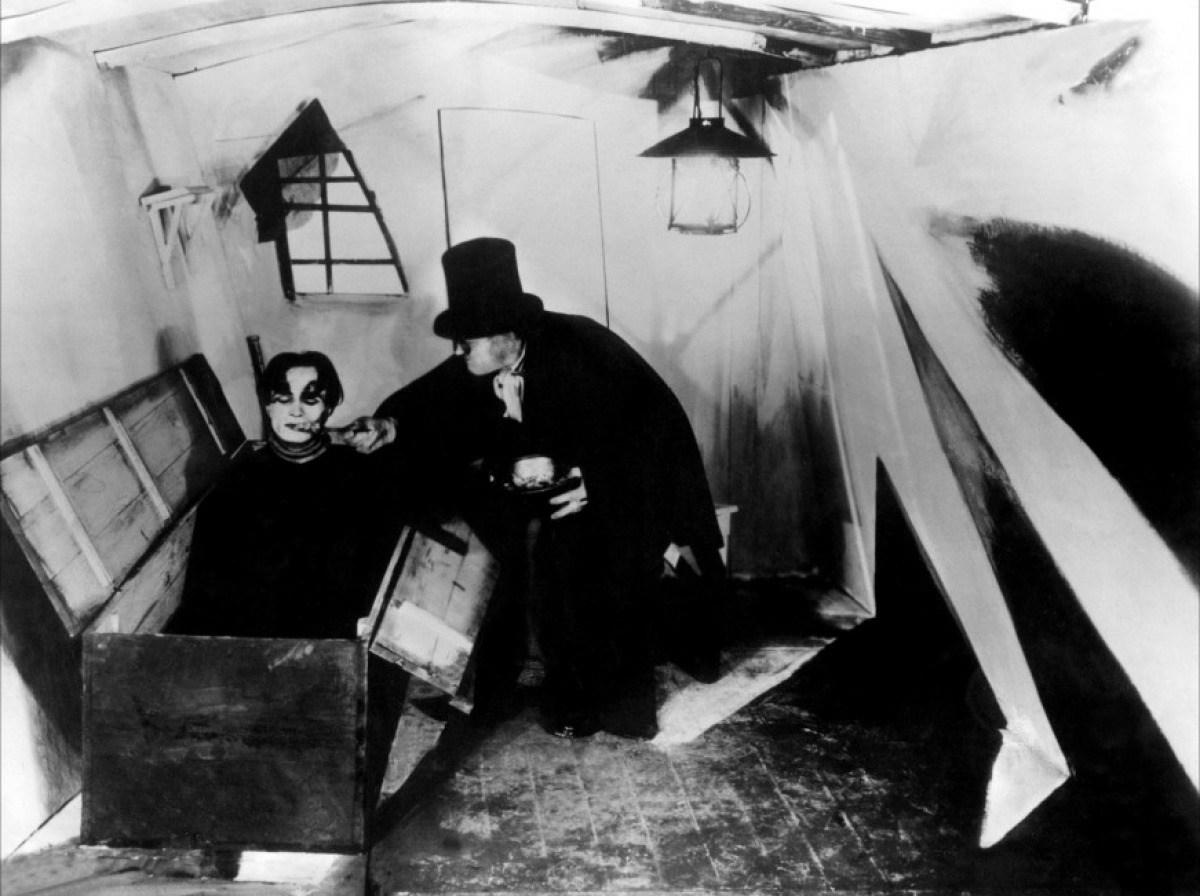
The Cabinet of Dr. Caligari could also be analysed and looked at from this point of view with the means to understand how camera angle and distortion of the backgrounds can create an alternate reality and mess with our heads. Nosferatu is another German Expressionist film that uses similar techniques and would be useful to watch.
'Psychiatric Tales' as I have already spoken about has been a massive influence for my practical as I feel I can confidently approach a difficult subject in a way that is informative and helpful to others without being too offensive and without the need to sensationalise other people's difficult issues.
Practical Research
"Real Monsters Art" by Toby Allen was sent to me by a fellow animator and looked incredibly interesting due to the fact that I will possibly be creating my own creatures or 'hallucinations' for my practical animation(s). Toby Allen creates monsters that represent different mental disorders and exactly why their appearance reflects how they manifest and show themselves.
M.C Escher's work will be fairly relevant as I plan to look at the ways he uses perception and perspective to create a sense of uncertainty and surrealism. His works feature highly mathematical-based geometry which could reflect the way a delusional or hallucinating mind uses heavy symbolism, often featuring numbers, geometry, and personal imagery. German Expressionism, which inspired Tim Burton seems have a very macabre feel to it and would be good to analyse and use as inspiration for some of the environmental design in my animation(s) as I would like to represent how it feels to live with hallucinations and a sense of reality being taken away. The idea of distortion and playing between what is real and what is confined within the mind is incredibly hard to interpret to an audience whose versions of reality are fairly unclouded, so using German Expressionism as a means of inspiration (we can all agree that Escher's and even Burton's re-worked version of the style challenges reality and makes us wonder if our mind is playing tricks (Metamorphosis II by M.C Escher cleverly plays between 2D and 3D perception.)
| Left - Drawing Hands (Escher) Right - Relativity (Escher) |
The Cabinet of Dr. Caligari could also be analysed and looked at from this point of view with the means to understand how camera angle and distortion of the backgrounds can create an alternate reality and mess with our heads. Nosferatu is another German Expressionist film that uses similar techniques and would be useful to watch.
| Still from 'The Cabinet of Dr. Caligari' |
OUAN601 - COP3: Dissertation Primary Research
OUAN601 - COP3:
Dissertation Research
As part of my dissertation research, I planned to contact and visit some professional companies and practitioners to ask them some valuable questions and learn about the work they are undertaking that is relevant to the way mental health is portrayed in animation.
So far I have spoken to Darryl Cunningham, illustrator and creator of 'Psychiatric Tales', a graphic novel about his time as a mental health worker and the difficulties he encountered. I emailed him regarding his views on the way in which animation depicts psychological issues and what he would do differently if he were to create an animated piece of his illustrated works. He replied with a very detailed and helpful response as he agreed that it can be very difficult to appropriate animation in a way in which is suitable and with the sole purpose to inform without being offensive or too controversial. Facts are key to authenticity:
"Hi Grace
Thanks for your kind words. I'm always pleased when people tell me that my work has helped or inspired them. I've tried to answer your questions below...
Yes I do think they're appropriate. Why not? As long as they are respectful to the people documented and are backed by facts rather than myths, then I think both illustration and animation have a lot to offer. They are easy to consume and can present a great deal of information quickly. My own approach, no matter what the subject, is to make the drawing within my comic strip panels as simple as possible. I often have a lot of information to present, so I don't want the reader to be confused by difficult page layouts or confusing imagery. Just because something looks easy to read doesn't mean that it can't resonate with people on a deep level and contain complex messages.
For people who suffer from a mental illness reading can be therapeutic, assuming of course, that they have the concentration. For those who are distressed it will help distract them from tormenting thoughts. Watching an animation might be even easier as a way of giving therapeutic help.
Hope that helps
Best"
I contacted Allie Brosh ('Hyperbole and A Half: Adventures in Depression' creator) to ask his opinions on animated works tackling this subject. However, there has been no reply despite a few pokes and nudges of encouragement. On a brighter note, I will be visiting Thought Bubble 2015 to try and hand out a questionnaires and achieve a response rate of at least 200+ people (I'm probably being ambitious!) I have yet to hand out the questionnaires to a smaller group within college to see whether or not it will be successful on a larger scale.
Dissertation Research
As part of my dissertation research, I planned to contact and visit some professional companies and practitioners to ask them some valuable questions and learn about the work they are undertaking that is relevant to the way mental health is portrayed in animation.
So far I have spoken to Darryl Cunningham, illustrator and creator of 'Psychiatric Tales', a graphic novel about his time as a mental health worker and the difficulties he encountered. I emailed him regarding his views on the way in which animation depicts psychological issues and what he would do differently if he were to create an animated piece of his illustrated works. He replied with a very detailed and helpful response as he agreed that it can be very difficult to appropriate animation in a way in which is suitable and with the sole purpose to inform without being offensive or too controversial. Facts are key to authenticity:
"Hi Grace
Thanks for your kind words. I'm always pleased when people tell me that my work has helped or inspired them. I've tried to answer your questions below...
Yes I do think they're appropriate. Why not? As long as they are respectful to the people documented and are backed by facts rather than myths, then I think both illustration and animation have a lot to offer. They are easy to consume and can present a great deal of information quickly. My own approach, no matter what the subject, is to make the drawing within my comic strip panels as simple as possible. I often have a lot of information to present, so I don't want the reader to be confused by difficult page layouts or confusing imagery. Just because something looks easy to read doesn't mean that it can't resonate with people on a deep level and contain complex messages.
For people who suffer from a mental illness reading can be therapeutic, assuming of course, that they have the concentration. For those who are distressed it will help distract them from tormenting thoughts. Watching an animation might be even easier as a way of giving therapeutic help.
Hope that helps
Best"
I contacted Allie Brosh ('Hyperbole and A Half: Adventures in Depression' creator) to ask his opinions on animated works tackling this subject. However, there has been no reply despite a few pokes and nudges of encouragement. On a brighter note, I will be visiting Thought Bubble 2015 to try and hand out a questionnaires and achieve a response rate of at least 200+ people (I'm probably being ambitious!) I have yet to hand out the questionnaires to a smaller group within college to see whether or not it will be successful on a larger scale.
The plan is to contact David Firth of Fat Pie for his opinions on 'Salad Fingers' and mental health. One of my chapters/topics I chose to write about was the sensationalisation of mental health and how this can affect an audience into believing illness is a 'trend'. I believe that certain cartoons and pieces could well be seen as culprits for popularising topics such as depression, anxiety, and psychosis to name a few. I wish to understand why he chose to deliver 'Salad Fingers' in such a shocking way.
I also wish to contact Biomation in York who work on mental health animations aimed a younger audience. This would be particularly helpful as I would like to understand the differences between how this subject is shown and appropriated for different audiences. Biomation use characters and puppets to relate more to the audience and have a more personal connection without being too heavy.
I'll be visiting LIFF (Leeds International Film Festival) soon to go and see The Cabinet of Dr. Caligari as research into style and how German Expressionism was used to influence Tim Burton (who hints at mental health with his creepy style and techniques), and to watch a talk on 'Film to Change', a talk and screening on mental illness and animation.
I've also been looking into an 'Animation and Public Engagement Symposium' at the Tyneside Cinema in Newcastle with HEART (Healing Education Animation Research Therapy). This would be relevant for a couple of modules as I'm looking into teaching and art therapy so might be worth going to just to see what's going on. Animation Therapy 2015
Subscribe to:
Comments (Atom)